How Anger Pride and Fear Expose Our Weaknesses and Shape Our Choices

Anger, pride, and fear are like emotional flashlights. They don’t just light up what’s happening around us, they reveal the messy basement of the self. You know, the one with old grudges, fragile ego boxes, and a suspicious pile labeled “things I’m avoiding.”
These emotions aren’t “bad.” They’re useful. Anger can defend boundaries. Pride can help us stand tall. Fear can keep us from petting a raccoon behind a gas station, which is, scientifically speaking, a solid life choice.
But when they run the show, they expose our weak spots. They point to what we protect, what we overvalue, and what we’re afraid to lose.
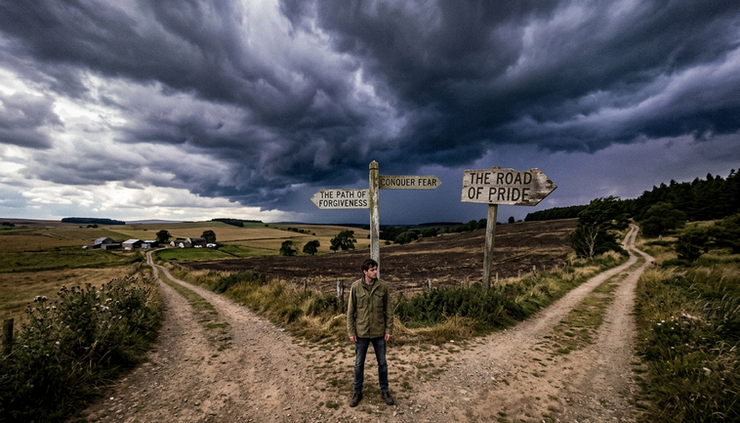
Anger shows where we feel threatened
Anger often looks powerful, but it usually has a soft underbelly. It can reveal places where we feel disrespected, ignored, embarrassed, or out of control.
Psychologist Paul Ekman, known for his work on emotions and facial expressions, described anger as a response that often arises when something blocks our goals. That “something” might be a traffic jam, a rude comment, or a dishwasher loaded so chaotically it feels like a personal attack.
Anger narrows attention. It pushes the brain toward action, fast. That can help in a real threat, but it can also make us sloppy decision-makers. Research by Jennifer Lerner and Dacher Keltner on the appraisal tendency framework suggests anger can make people feel more certain and more in control, even when the situation is risky. In plain English, anger can hand us a megaphone and say, “Don’t worry, you’re definitely right.”
Real-life example: someone gets criticized at work, goes home, and snaps at their partner over laundry. The laundry is innocent. The real wound is humiliation. Anger exposes the weak spot, maybe a deep need to be seen as competent.
A useful reflection question:
What did my anger protect today?
Not “Who deserves my wrath?” That’s the villain monologue version. Ask what felt unsafe, unseen, or unfair.
Pride reveals what the ego is guarding
Pride has two flavors. One is healthy, like finishing a tough project or finally assembling furniture without creating a chair-shaped crime scene. The other is defensive, brittle, and allergic to feedback.
Psychologists Jessica Tracy and Richard Robins have studied pride as having distinct forms, often described as authentic pride and hubristic pride. Authentic pride connects to effort and growth. Hubristic pride connects to superiority and ego protection.
That second kind can expose a weakness fast. If someone can’t admit they’re wrong, can’t apologize, or needs every conversation to end with them looking smart, pride may be covering insecurity.
Pride affects decision-making by making us protect our image over our goals. We double down on bad choices because changing course feels like losing status.

Think of a driver who refuses to ask for directions. Yes, GPS exists now, but the emotional software remains ancient. “I’m not lost,” they say, while circling the same block like a confused shark.
A more serious example shows up in leadership, parenting, friendships, and marriages. A person makes a poor choice, then spends more energy defending the choice than repairing the damage. Pride whispers, “If you apologize, you shrink.” But often, apology does the opposite. It proves the ego isn’t driving the clown car.
Try asking:
Where do I feel the need to be impressive instead of honest?
That question can sting. Good. A little sting means the spotlight found something real.
Fear exposes what we think we cannot handle
Fear is the brain’s alarm system. Very useful when danger is real. Less useful when it treats a difficult email like a tiger with dental issues.
Neuroscientist Joseph LeDoux’s work helped popularize the role of the amygdala in fear processing. The amygdala helps detect threats quickly, sometimes before the thinking brain has caught up. That speed can save us. It can also make us overreact.
Fear often reveals our beliefs about helplessness. It points to the places where we think, “I won’t survive embarrassment,” “I can’t handle rejection,” or “If this changes, I’ll fall apart.”
Fear shapes decisions by making safety feel better than growth. We avoid hard conversations, stay in stale routines, or choose the familiar problem over the unfamiliar possibility. The familiar problem has furniture. It’s ugly furniture, but still.
Psychological research on loss aversion, associated with Daniel Kahneman and Amos Tversky, shows people often feel losses more strongly than equivalent gains. That helps explain why fear can make us cling to situations that aren’t good for us. The pain of possibly losing feels louder than the hope of gaining.

A real-life example: someone wants to leave a draining job, but fear says, “What if nothing better comes?” That fear may reveal a weakness in self-trust. The issue isn’t only the job. It’s the belief that they can’t adapt.
Ask:
What am I avoiding because I don’t trust myself to handle the outcome?
That one deserves a quiet walk, or at least a snack and five minutes away from your phone.
Anger, pride and fear become teachers when we slow down
Anger, pride, and fear get dangerous when we obey them instantly. The trick is not to crush them. That usually backfires. Ever tried not to be angry? Congratulations, now you’re angry and annoyed at yourself.
Instead, pause long enough to read the message.
Here’s a simple way to work with all three:
Emotion | What it may reveal | Better question to ask |
Anger | A boundary, wound, or blocked goal | What feels threatened right now? |
Pride | A fragile identity or need for status | What am I trying to prove? |
Fear | A lack of trust in your ability to cope | What do I think I can’t handle? |
This pause matters because emotions change what information we notice. Anger looks for blame. Pride looks for status. Fear looks for danger. Each one edits reality like a dramatic movie trailer.
The goal is to become curious before becoming reactive. Curiosity gives the thinking brain a chance to rejoin the group chat.

The real weakness is refusing to look
Everyone gets angry. Everyone feels pride. Everyone gets scared. The weakness isn’t having these emotions. The weakness is pretending they have nothing to teach us.
The next time anger flares, pride stiffens, or fear whispers disaster stories, try not to treat the emotion as the final answer. Treat it like a messenger who arrived sweaty, dramatic, and maybe slightly wrong.
Ask what it’s pointing toward.
Anger may show where you need a boundary. Pride may show where honesty needs to beat image. Fear may show where trust has to be rebuilt, one brave choice at a time.
Emotions don’t expose weakness to shame us. They expose it so we can stop letting it run our lives from the basement.


Comments