Your Inner Artist: 5 Simple Ways to Boost Creativity

A blank canvas can feel less like an invitation and more like it’s silently judging you from across the room. Rude, honestly.
But making art doesn’t require a mysterious talent gene, a dramatic studio loft, or a scarf you wear indoors for “creative reasons.” It starts with small choices: pick up a pencil, notice a color, make one brave mark, then another. Creativity grows when you give it somewhere to land, even if that place is the back of an envelope during lunch.
Here are five simple ways to loosen up, start creating, and let your Inner Artist out for some fresh air.

1. Make peace with the blank canvas
The blank canvas is famous for one thing: pretending it’s a final exam. It isn’t. It’s just fabric, paper, wood, or whatever surface you’re working on. It has no opinions. It isn’t whispering, “Do better, Picasso.”
The best way to beat blank-canvas fear is to make a bad first mark on purpose. Draw a loose circle. Swipe on a background wash. Make a tiny dot in the corner. Once the surface is no longer perfect, the pressure drops fast.
Try this quick warm-up:
Set a timer for five minutes.
Pick one color.
Fill the page with lines, blobs, shapes, or patterns.
Don’t make anything “good.”
Stop when the timer ends.
That tiny exercise tells your brain, “We’re playing, not performing.” And play is where the good stuff sneaks in wearing fake glasses and a mustache.
2. Start with a simple sketch
Jumping straight into a finished painting can feel like trying to cook Thanksgiving dinner after watching one short video about potatoes. Sketching gives you a softer start.
A sketch doesn’t have to be pretty. It’s a map. A messy, coffee-stained, “turn left at the weird tree” kind of map. Sketching helps you test where things go before you commit paint, ink, or glue to the page.
Start with basic shapes:
A mug becomes a cylinder.
A house becomes squares and triangles.
A face becomes an oval with guide lines.
A flower becomes circles, stems, and curved lines.
If you’re drawing from life, don’t worry about capturing every detail. Look for the big shapes first. Then add smaller details once the structure feels right.
A helpful rule: sketch lightly, judge lightly. You’re not signing a contract. You’re just introducing your idea to the page.

3. Try different mediums without marrying them
Some people fall in love with watercolors. Some people love acrylics. Some people discover collage and suddenly every old magazine is “art supplies.” No judgment. The recycling bin had it coming.
Different mediums teach different lessons.
Watercolor teaches patience because it does whatever it wants, like a cat with pigment. Acrylics let you layer and cover mistakes, which is comforting if your first attempt looks like a confused vegetable. Colored pencils reward slow building. Charcoal lets you get dramatic fast. Mixed media gives you permission to combine paper, paint, ink, and texture into one big creative stew.
You don’t need to buy an entire art store. Start small:
Watercolor
Acrylic paint
Colored pencils
Collage
Great for loose color, washes, and soft effects
Good for bold layers and easy corrections
Perfect for control, detail, and portable practice
Fun for composition, texture, and using found materials
Pick one new medium and make a test page. Paint swatches. Scribble lines. Layer colors. Write little notes beside each test. Treat it like a science experiment, except with fewer lab coats and more accidental thumbprints.
4. Find inspiration in normal, everyday stuff
You don’t have to wait for a lightning bolt of inspiration. That sounds exhausting, and also unsafe.
Inspiration is usually hiding in plain sight: the orange peel on your kitchen counter, the shadow of a chair, the weirdly beautiful pattern on a leaf, the way sunlight hits a glass of water. The trick is to slow down long enough to notice.
Take a short “artist walk” around your home, yard, neighborhood, or local park. Bring your phone or a small notebook. Look for:
Interesting shadows
Color combinations
Textures like bark, brick, fabric, or peeling paint
Repeating shapes
Ordinary objects with odd personality
A spoon can become a study in reflection. Sneakers can become a shape exercise. A pile of laundry can become, well, maybe still laundry. Some subjects need boundaries.
The more you practice noticing, the more material you collect for future art. Your daily life is already stocked with ideas. You just have to put on your “what if I painted that?” glasses.
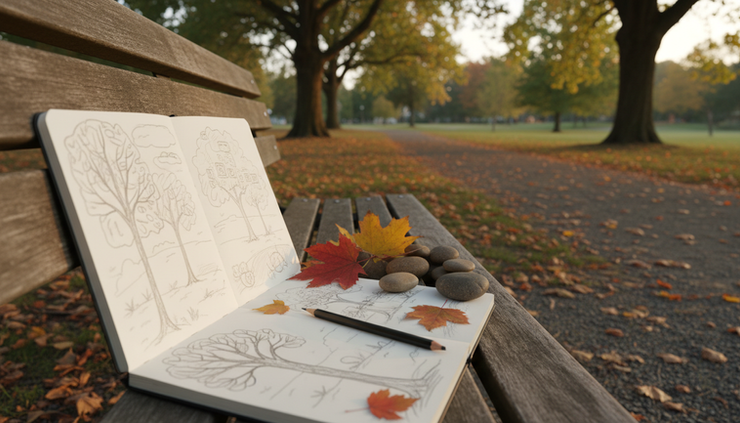
5. Practice in tiny, repeatable bursts
Practice sounds like homework, but it doesn’t have to be a grim march through 400 identical apples. A few minutes a day can do more than one giant art session that leaves you tired, cranky, and covered in paint like you fought a rainbow.
Set a realistic rhythm. Ten minutes counts. Five minutes counts. One tiny sketch while waiting for pasta water to boil counts. The goal is consistency, not artistic suffering.
Try one of these mini-practices:
Draw one object from your kitchen.
Paint one color study.
Make a page of patterns.
Sketch your hand in three different poses.
Copy the shape of a leaf, shell, or flower.
Fill a page with faces that look slightly concerned.
Small practice builds confidence because it removes the drama. You don’t need to create a masterpiece every time. You just need to show up often enough that making art starts to feel normal.
And yes, some days your drawing will look like a potato wearing a hat. Keep it anyway. Those pages prove you’re learning.

Let your creativity be allowed to grow
The fastest way to stall is to expect every piece to be impressive. Art grows better when you let it be awkward first. Give yourself room to experiment, make weird marks, change direction, and learn as you go.
Start with one small step today. Make a mark. Sketch a mug. Mix two colors just to see what happens. Creativity isn’t waiting for perfect conditions. It’s waiting for you to stop arguing with the blank page and begin.


Comments