Breaking Free from Analysis Paralysis How to Decide and Move Forward

Ever spent 45 minutes choosing a movie, only to give up and watch the same show again? Congratulations, you’ve met analysis paralysis, the sneaky little gremlin that turns simple choices into a full courtroom drama.
Analysis paralysis happens when you overthink a decision so much that you stop moving forward. Instead of choosing, trying, learning, or adjusting, you get stuck collecting more information, comparing more options, and imagining every possible outcome. It feels productive, but it often keeps you circling the runway without ever landing the plane.
The good news? You don’t need to become a fearless decision-making robot. You just need a few practical ways to get unstuck.

What analysis paralysis looks like in real life
Analysis paralysis can show up in big decisions, like changing jobs, moving, starting a project, or ending a commitment. It can also ambush tiny choices, like which shoes to buy or what to order for lunch. That last one is especially rude, because hunger plus indecision is basically a low-budget horror movie.
Common signs include:
You keep researching after you already have enough information. The tenth comparison video probably won’t reveal the wisdom of the universe.
You ask everyone for advice, then feel more confused. Now you have seven opinions, three warnings, and one uncle who says to “trust your gut” while eating cereal for dinner.
You delay the decision for “just one more day.” One more day becomes one more week, then suddenly the opportunity has packed a bag and left.
You imagine the worst-case scenario on repeat. Your brain becomes a tiny disaster movie director.
You feel tired before you even act. Mental spinning uses real energy, even if nothing outwardly happens.
At its core, analysis paralysis often feels like safety. If you don’t choose, you can’t choose wrong. But staying stuck has a cost too. It can drain confidence, waste time, and make decisions feel scarier than they really are.
Why people get stuck overthinking
Most people don’t fall into this trap because they’re lazy or incapable. Usually, they care. A lot. Sometimes too much.
One major reason is fear of failure. Nobody wants to make a choice that leads to regret, embarrassment, wasted money, or a sad trombone sound effect. So the brain tries to protect you by demanding certainty.
The problem is, certainty is rarely available. You can read reviews, make lists, and consult trusted people, but you still won’t know everything ahead of time. Life does not hand out spoiler alerts.
Another common cause is perfectionism. Perfectionism whispers, “There is one correct answer, and if you miss it, everything collapses.” That sounds dramatic because it is. Many decisions have several decent options, not one magical golden door.
Then there’s option overload. When you have too many choices, choosing can feel harder, not easier. Picking one flavor from three is pleasant. Picking one from 47 starts to feel like a graduate exam in frozen dairy studies.

How to break the loop and make a decision
Getting unstuck usually means making the decision smaller, safer, and less dramatic. Here are practical ways to do that.
Set a real deadline
Open-ended decisions love to sprawl. Give them a fence.
Try this:
Small decision Give yourself 10 minutes.
Medium decision Give yourself 24 to 48 hours.
Bigger decision Set a date when you’ll choose, then decide what information you need before that date.
A deadline does two useful things. It forces focus, and it reminds you that deciding is part of the task, not a bonus round.
Limit your options
If you’re comparing 19 possibilities, cut the list down to three. Not because the other 16 are evil, but because your brain has limits. It is not a supercomputer. It is a squishy decision potato doing its best.
Ask yourself:
Which options clearly meet the basic need?
Which ones can I remove because they are too expensive, too complicated, or not realistic?
If I had to choose today, which two or three would remain?
Fewer options often bring more clarity.
Define “good enough” before you choose
Perfectionism moves the finish line. Beat it by defining success early.
For example:
“A good enough apartment is safe, within budget, and close enough to work.”
“A good enough laptop handles my daily tasks and lasts a few years.”
“A good enough workout plan is one I’ll actually do three times a week.”
This turns the decision from “find the perfect thing” into “find something that meets the real need.” Much better. Less glitter, more progress.
Use a test run when possible
Not every decision has to be permanent. Try a trial version.
Before committing fully, you might:
Take a class before buying all the equipment.
Try a new routine for two weeks.
Start a side project before making it your main focus.
Choose a month-to-month option instead of a long contract.
A test run gives real feedback. Real feedback beats imaginary panic almost every time.

Why most decisions are more adjustable than they feel
Here’s a comforting truth: most decisions are not carved into stone by a moody wizard.
Many choices can be changed, improved, paused, reversed, or adapted later. You can update a plan, switch tools, apologize, renegotiate, sell something, learn from a mistake, or choose again with better information.
That doesn’t mean decisions don’t matter. They do. But treating every choice like a final exam makes life heavier than it needs to be.
Try sorting decisions into two buckets:
Hard to reverse
Buying a house, signing a long contract, making a major medical choice
Easier to adjust
Trying a hobby, choosing a restaurant, changing a schedule, starting a small project
For hard-to-reverse decisions, slow down and gather solid input. For easier-to-adjust decisions, move faster. Don’t use “buying a house” energy on “which sandwich should I get” problems. The turkey club does not deserve that level of legal review.
Build your decision-making muscles
Deciding gets easier with practice. The goal isn’t to never feel uncertain. The goal is to act even when uncertainty is sitting nearby eating popcorn.
Start small. Pick one low-risk decision today and make it without turning it into a research festival. Choose the recipe. Send the email. Sign up for the class. Toss the socks with holes. They’ve served bravely.
Afterward, notice what happened. Did the world end? Probably not. Did you learn something? Probably yes.
You can also use a simple reflection habit:
What did I choose?
What information did I use?
What happened after I acted?
What would I do differently next time?
This builds trust in your ability to decide, adjust, and keep going.
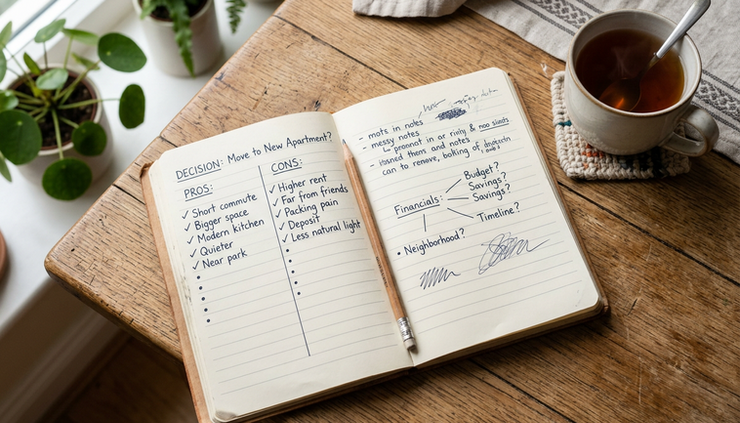
Take the next step before your brain opens 27 more tabs
Analysis paralysis thrives when choices feel permanent, perfect, and dangerous. Shrink the choice. Set a deadline. Limit the options. Define good enough. Take a test step if you can.
Most of all, remember that action gives you information that thinking alone cannot. You can adjust more decisions than you think, and a slightly imperfect step forward often beats a perfectly polished standstill.
So, what decision have you been circling lately? Make the next small move, then share your experience with someone you trust. Your story might help them get unstuck too, and at the very least, you’ll both have something better to discuss than 47 ice cream flavors.


Comments