“I Don’t Have Time” Or Am I Just Avoiding What Matters

“I don’t have time” is the Swiss Army knife of excuses. It fits everything. Exercise? No time. Call a friend? No time. Start the thing you keep talking about? Tragically, no time. Meanwhile, your phone screen time report is standing in the corner wearing sunglasses and holding receipts.
The truth is, we all have full days. Work, chores, family, errands, appointments, dishes that somehow reproduce overnight like tiny ceramic rabbits. Life is busy.
But sometimes, “I don’t have time” doesn’t mean we lack hours. It means the goal isn’t important enough yet, it scares us, or we’ve buried it under a pile of low-stakes distractions that feel easier to face.
That’s not a character flaw. It’s human. But it is worth noticing.

“I don’t have time” often means something else
Time is wonderfully honest. Annoying, but honest. We all get the same 24 hours, which is rude because some people seem to use theirs to run marathons, meal prep, learn Italian, and still have shiny hair.
But the phrase “I don’t have time” is often shorthand for one of these:
I don’t actually want this enough
I’m afraid I’ll be bad at it
I don’t know where to start
I’m overwhelmed
I’d rather avoid the discomfort
I’m choosing something easier right now
That last one stings a little, like stepping on a Lego. But it’s useful.
Maybe you say you want to write, but every evening becomes “just one episode,” followed by three episodes and a snack you don’t remember choosing. Maybe you want to get healthier, but planning meals feels like decoding a submarine manual. Maybe you want to apply for a better job, but updating your resume makes you feel like a raccoon filling out a government form.
Avoidance wears many costumes. Busyness is one of its favorites.
Busyness can feel productive while quietly stealing your life
There’s busy, and then there’s fake busy.
Real busy sounds like paying bills, taking care of people, working, resting, cooking, cleaning, getting where you need to go, and handling the regular chaos of being a person with a laundry basket.
Fake busy is sneakier. It looks responsible from a distance, but up close it’s mostly motion.
Checking email every 11 minutes. Rearranging apps. Researching the perfect planner instead of using a piece of paper. Watching 14 reviews before buying a $12 water bottle. “Catching up” on things that never end.
The tiny stuff can become a fog machine. Before you know it, the day is gone and the important thing is still sitting there, tapping its foot.
The question is not “Am I busy?” The better question is “What is my busyness protecting me from?”
That question gets spicy fast.
Sometimes busyness protects us from boredom. Sometimes from guilt. Sometimes from the possibility that if we try, we might fail. And if we fail at something that matters, ouch. Better to stay “too busy,” right?
Except that keeps the dream perfectly safe and perfectly untouched.

Take a brutally honest look at where the time goes
You don’t need to overhaul your life with a 47-tab spreadsheet and a motivational playlist called “Beast Mode Breakfast.” Start smaller.
For one or two days, track what you actually do. Not what you think you do. What you do.
Write it down in rough blocks:
Woke up and scrolled
Made breakfast
Worked
Watched videos
Cleaned
Texted
Ran errands
Watched more videos while “figuring out dinner”
Avoided the thing
Felt weird about avoiding the thing
Went to bed
No shame. This is not a courtroom drama. You are not the defendant, and your couch is not testifying against you.
The goal is to spot patterns.
Look for the soft spots in your day. The 20-minute gaps. The autopilot habits. The tasks that expand like bread dough because you don’t give them a container.
Then ask:
What did I do that mattered?
What did I do because it was urgent?
What did I do because it was easy?
What did I do because I was avoiding something?
What could I stop, shrink, or move?
You may not find three magical free hours. Most people don’t. But you might find 15 minutes here, 30 minutes there, and a few habits that have been quietly charging rent in your life.
That’s enough to begin.
Make important goals smaller and less dramatic
Big goals attract big avoidance.
“Write a book” sounds like climbing a mountain while carrying a piano. “Write 200 messy words” sounds manageable. Maybe still annoying, but manageable.
“Get fit” is vague and intimidating. “Take a 10-minute walk after lunch” is simple.
“Fix my finances” is a thundercloud. “Open the bank app and look at the numbers without screaming” is progress. Quiet progress, but progress.
The trick is to lower the emotional temperature. Your brain can handle a small next step better than a life-changing identity quest.
Try this:
Name the real goal
Be specific. “I want more time for myself” is a foggy goal. “I want three evenings a week to work on my music” gives you something to protect.
Pick the next visible step
Make it so clear you can’t wiggle out of it. “Research options” is mushy. “Spend 15 minutes listing three beginner guitar lessons” is clear.
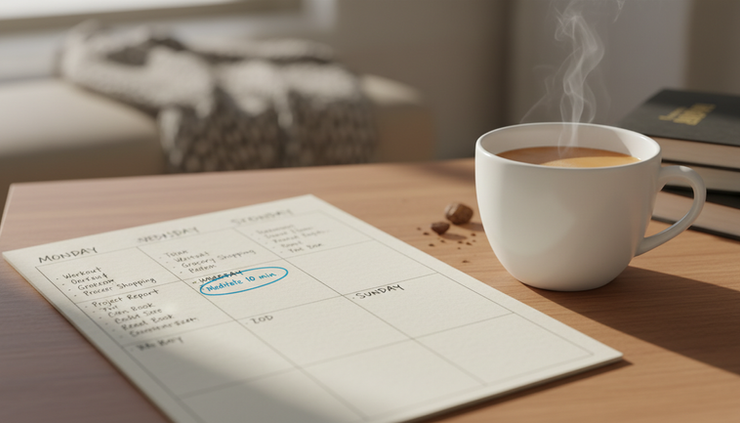
Put it on the calendar
If it lives only in your head, it’s competing with snacks, notifications, and the sudden need to clean the spice cabinet.
Make the first version ugly
Fear loves perfection. Tell yourself the first attempt is allowed to be awkward, boring, clumsy, or held together with duct tape and hope.
Fear of failure is a terrible project manager
Fear is loud, dramatic, and usually overdressed for the occasion.
It tells you that starting means you must succeed immediately. It tells you everyone will notice if you struggle. It tells you waiting is safer.
But waiting has a cost too. It can turn into months or years of almost starting. That “someday” folder gets heavy.
Try treating fear like background noise rather than a stop sign. You don’t have to feel confident to begin. Confidence often shows up after evidence, not before it.
Give yourself a low-pressure rule:
Do it badly for 10 minutes.
That’s it. Ten minutes of the thing, with permission to be unimpressive.
Practice the language for 10 minutes. Stretch for 10 minutes. Draft the email for 10 minutes. Sketch the idea for 10 minutes. Open the file you’ve been avoiding and stare at it like it owes you money.
Often, starting is the hardest part because it breaks the spell. The monster under the bed turns out to be a pair of shoes and one very judgmental dust bunny.
Protect what matters before the leftovers eat it
Most people give their best focus to everyone else’s priorities, then offer their own goals the crumbs. Crumbs are great for ducks. Not so great for building a meaningful life.
If something matters, give it a protected slot. Not a fantasy slot, like “Saturday, after I become a completely different person.” A real slot.
Try one of these:
Choose one “must matter” task each day
Set a 25-minute timer and stop when it ends
Put your phone in another room, yes, it will survive
Say no to one low-value thing this week
Pair the goal with an existing habit, like after coffee or before dinner
Tell one safe person what you’re working on
You don’t need a perfect schedule. You need a little honesty, a little courage, and fewer escape hatches.

The next time “I don’t have time” pops out of your mouth, pause for two seconds. Not to shame yourself. Just to ask what’s underneath it.
Maybe you truly don’t have room right now. That happens.
But maybe you do have time, just not for everything. Maybe the real work is choosing what gets your attention before the loud, easy, glittery nonsense grabs it first.
Start with 10 minutes. Start badly. Start before you feel ready.
That counts. And honestly, it beats reorganizing the spice cabinet again.


Comments